Geology
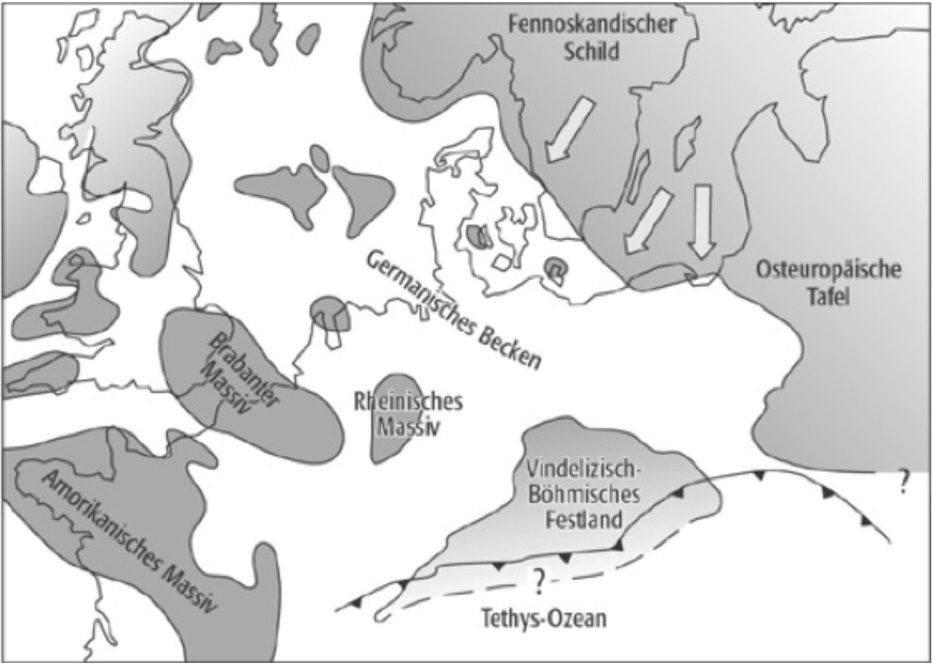
The Horst-Peter-Stollen gypsum-anhydrite mine is in a geological formation called the “Trier-Bitburger Triassic Syncline”. The Triassic deposits found here (dating back 253-202 million years) are part of the larger Germanic Basin. The syncline is situated between the Rhenish and London-Brabant Massifs. The geological cross-section below shows the exact location of the mine and the most significant geological features of the Trier-Bitburger Triassic Syncline. The gypsum deposit is in the Muschelkalk rock layer (Muschelkalk dating back 246-239 million years).
The geological cross-section below shows the exact location of the mine and the most significant geological features of the Trier-Bitburger Triassic Syncline. The gypsum deposit is in the Muschelkalk rock layer (Muschelkalk dating back 246-239 million years).
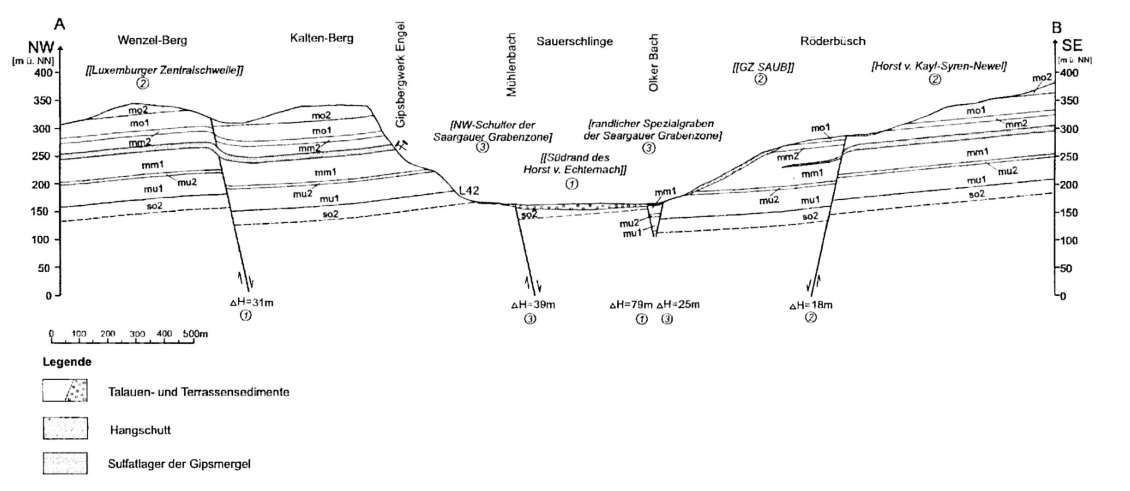
The deposit that is currently being worked is about ten metres thick. Gypsum is a so-called evaporite rock. When seawater gets trapped in a restricted basin and begins to evaporate, it becomes more concentrated and enriched in minerals. Over a certain level of concentration, the minerals precipitate to form gypsum (CaSO4 * 2 H2O). As this diagenesis continues, the water evaporates completely, forming anhydrite (CaSO4) or, in other words, “water-free gypsum”. Later, in the right conditions, anhydrite can partly or fully turn back into gypsum.
Our offices
Gips Bergbau ENGEL GmbH
Auf der Hill 6 a
54295 Trier, Germany
Phone: +49 651 33131
Fax: +49 651 308361
info@engel-bergbau.de
Production
Gips Bergbau ENGEL GmbH
Horst-Peter-Stollen
Zur Gipsgrube 1
54310 Ralingen,
Germany
Phone: +49 6585 839
Fax: +49 6585 991218
produktion@engel-bergbau.de